
Five Things I Always Notice When I Walk Into a Soap or Skincare Store
The five little things I always notice the moment I walk into a soap or skincare store — and what they tell me every time.
I can’t remember the last time I walked into a soap or skincare store and didn’t start quietly analysing everything around me.
I don’t mean to. It just happens.
My family would probably roll their eyes because they know exactly what’s coming. Before long I’ll be picking up bottles, turning them over to read the ingredients and quietly wondering why a formulator made one decision instead of another. I don’t do it to criticise anyone. I suppose it’s just curiosity, and after all these years I don’t think it will ever leave me.
The funny thing is, the first thing I usually notice isn’t a product at all.
It’s the smell.
Sometimes I can smell a store before I’ve even walked through the door. Some shops have a lovely, gentle fragrance that’s inviting without being overpowering. Others, though, are so heavily scented that my nose starts complaining almost immediately. There have actually been times when I’ve turned around and walked straight back out again because it was simply too much.
Now, that’s just me.
I know plenty of people love walking into a beautifully fragranced store, and scent is an important part of the experience for many brands. I’ve just always preferred things to be a little more subtle. If I’m buying a lavender cream, I’d much rather catch the gentle scent of lavender than be overwhelmed by added fragrance.
Once I’ve recovered from the smell, I usually start looking around at the colours.
Sometimes they’re beautiful. Soft creams, gentle greens, warm earthy browns… colours that remind me of the ingredients themselves.
But every now and then I see soaps in bright blue, vivid purple or fluorescent pink and I can’t help wondering why.
Perhaps it’s because I’ve spent so many years formulating products, but I think nature already gives us some beautiful colours. Clays have their own personality. Plant oils range from golden yellow to rich green. Botanical extracts bring subtle shades that tell their own story.
Of course, there are times when colour is simply fun. A brightly coloured soap might make someone smile, and there’s absolutely nothing wrong with that. I just find myself wondering whether the colour is there because it genuinely adds something to the product or simply because it catches our attention. Personally, I’d rather see the natural colour of the ingredients shining through.
Then I start turning bottles over.
I honestly don’t think I can help myself.
The front of the label might tell me all about aloe vera, Kakadu plum, vitamin C or hyaluronic acid, but I’m always interested in what the back of the bottle has to say. That’s where the real story begins.
Sometimes the ingredient being celebrated on the front appears exactly where I’d expect it. Other times it’s much further down the list than the marketing might lead you to believe.
That doesn’t automatically make it a poor product. Some ingredients work beautifully in very small amounts, while others are there to support the overall formulation. It’s just a reminder that good skincare is rarely about one hero ingredient. It’s about how every ingredient works together to create a balanced, stable and effective product.
Then, almost without thinking, I find myself looking at the packaging.
I genuinely appreciate good design because I know how much work goes into creating it. A beautiful bottle or an elegant label can make you want to pick something up, and there’s nothing wrong with that.
But years of formulation have taught me not to judge a product by its packaging.
I’ve seen beautifully presented skincare that didn’t particularly impress me once I looked beyond the label, and I’ve come across very simple-looking products that were thoughtfully formulated and performed wonderfully.
It’s a good reminder that the real value is inside the bottle, not wrapped around it.
By the time I’m ready to leave the shop, I’m usually walking away with ideas rather than purchases.
I might have discovered an ingredient I haven’t come across before, noticed an interesting packaging idea or simply appreciated the way another formulator approached a problem.
I don’t walk into soap and skincare stores looking for faults.
I walk in because I’m still curious.
After all these years, I still enjoy learning from what other people create. Sometimes I agree with their choices, sometimes I don’t, but there’s almost always something interesting to take away.
Perhaps that’s why I still enjoy wandering through soap and skincare stores.
I rarely leave without learning something.
Sometimes it’s a new ingredient I’d like to read more about. Sometimes it’s a clever packaging idea. Sometimes it’s a formulation that makes me stop and think, “That’s really well done.”
And sometimes it’s simply a quiet reminder that nature has been giving us wonderful ingredients all along—we just have to understand them, respect them and know how to use them well.
I don’t think I’ll ever stop looking.
And to be honest, I hope I never do.
Natural Doesn’t Always Mean Gentle
A natural label doesn’t automatically mean gentle — here’s how I really judge an ingredient.
One of the questions I’m asked most often is whether natural ingredients are always better for the skin.
It’s an understandable question. Over the past decade, more and more people have become interested in natural skincare. They’re reading ingredient labels, asking where ingredients come from, and wanting products that align with the way they choose to live. I think that’s a positive shift.
What I’ve also learnt, after many years of formulating skincare, is that the answer isn’t quite as simple as natural is good and synthetic is bad.
Nature is incredibly powerful. That’s one of the reasons I enjoy working with botanical ingredients. But powerful doesn’t always mean gentle.
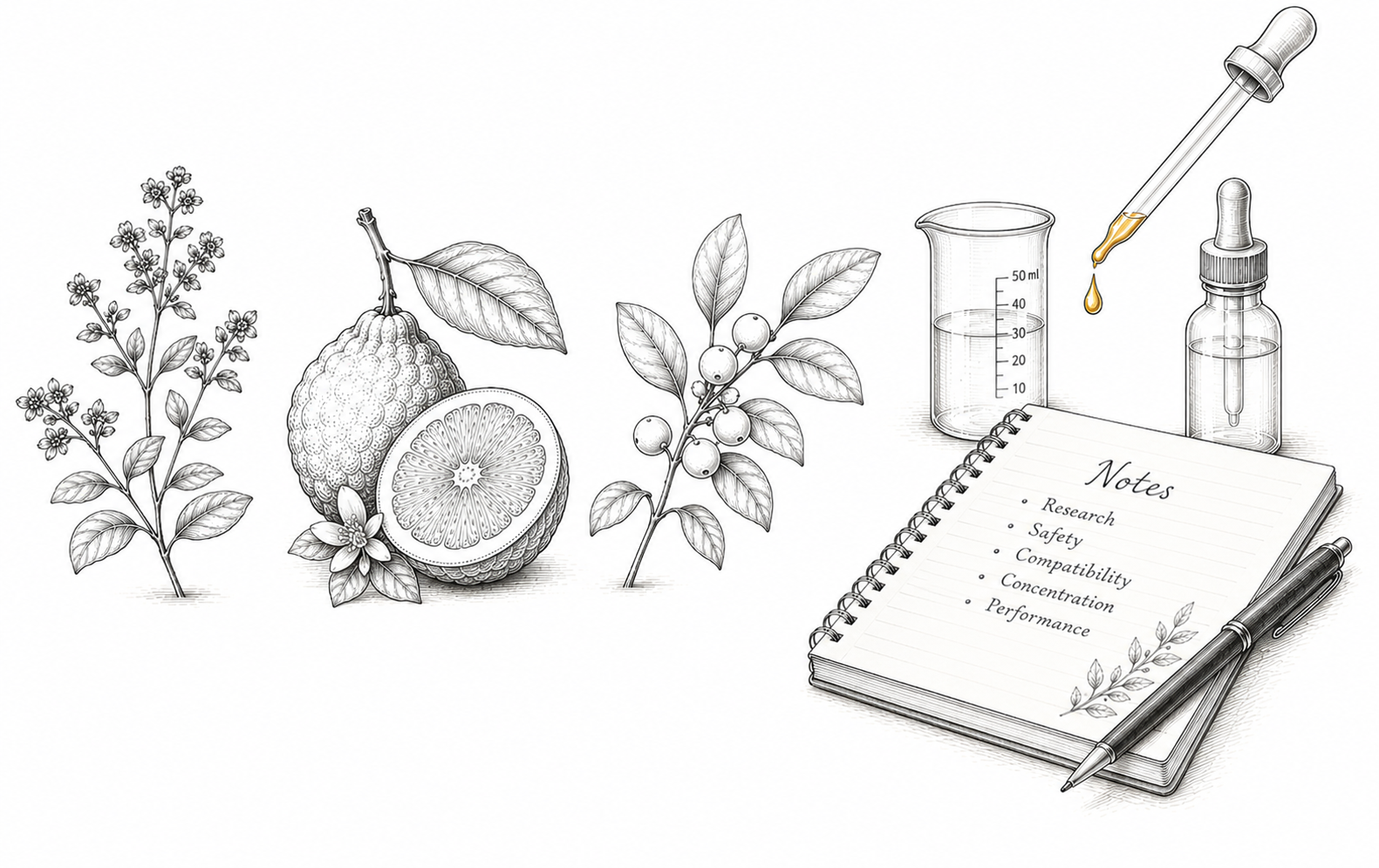
Some of the most irritating ingredients I’ve worked with are completely natural. Oregano essential oil, wintergreen oil and cassia oil, for example, all have wonderful properties, yet each has the potential to irritate the skin if it’s used at the wrong concentration or in the wrong formulation. Bergamot essential oil is another interesting example. Unless a bergapten-free version is used, it can increase the skin’s sensitivity to sunlight.
On the other hand, there are carefully selected synthetic ingredients that have been studied for decades, have excellent safety profiles, and perform consistently in well-formulated skincare products.
Over the years I’ve found myself asking different questions.
Rather than asking whether an ingredient is natural or synthetic, I ask:
Has it been well researched?
Is it appropriate for the product I’m creating?
Is it being used at a safe and effective concentration?
Does it work well with the other ingredients in the formulation?
For me, good formulation has never been about choosing sides. It’s about making thoughtful, informed decisions.
People often ask me, “What’s the best ingredient for ageing skin?”
The truth is, I’ve never looked at skincare that way.
A formulation isn’t simply a collection of individual ingredients. It’s a recipe.
Think about baking a cake. You wouldn’t judge the finished cake by the quality of the vanilla alone. The flour, eggs, butter, raising agent and baking time all matter just as much. It’s the balance between the ingredients that creates the final result.
Skincare is exactly the same.
You can include an extraordinary botanical extract, but if the emulsifier isn’t suitable, the preservative system isn’t appropriate, the pH isn’t balanced, or the supporting ingredients don’t work together, the finished product simply won’t perform the way it should.
The products I admire most aren’t built around one fashionable ingredient.
They’re built around balance.
Perhaps that’s one of the biggest lessons I’ve learnt after years of formulating.
Natural doesn’t automatically mean gentle.
Synthetic doesn’t automatically mean harmful.
The best skincare comes from understanding the strengths—and the limitations—of both.

The Aloe Vera on My Mother’s Porch
Long before I studied naturopathy, my mother was teaching me natural skincare with a pot of aloe vera on the porch.
Growing up in Queensland, summer holidays almost always ended the same way.
We’d spend hours at the beach or by the river, swimming until our fingers wrinkled and only coming out of the water when someone called us in for lunch. By the time we headed home, we were tired, happy… and usually sporting bright red shoulders from a little too much Australian sunshine.
Mum never made a fuss about it.
She had a large terracotta pot of aloe vera sitting on the front porch. She’d simply snap off one of the thick leaves, slice it open, and gently smooth the cool, clear gel over our sunburnt skin.
I can still remember how it felt.
The heat seemed to disappear almost instantly, replaced by that wonderfully cool, soothing sensation. At the time, it wasn’t something I thought much about. It was simply what Mum did, and I suspect many Australian families had their own version of the same ritual.
Looking back now, I realise those quiet moments were probably my very first introduction to natural skincare.
No one called it that, of course.
Mum wasn’t trying to follow a trend or recreate an ancient remedy she’d read about in a magazine. She simply reached for the plant growing a few steps from the front door because experience had taught her that it helped.
There’s something rather beautiful about that.
Long before I studied nutrition, Western herbal medicine, or began formulating skincare products, I was learning one of the most important lessons I’ve ever carried with me: nature often provides remarkable solutions if we’re willing to pay attention.
Over the years I’ve learned much more about aloe vera and why it has been treasured for thousands of years. Its gel contains polysaccharides that help retain moisture, while naturally occurring compounds have long been valued for their soothing properties. Today you’ll find aloe in everything from moisturisers and cleansers to after-sun products, but my mind never goes to a laboratory first.
It always goes back to that terracotta pot on Mum’s porch.
Even now, whenever I’m working on a new formulation and aloe appears on the ingredients list, I find myself smiling. Not because I’m thinking about skincare, but because I’m remembering where my own curiosity really began.
Sometimes our greatest teachers aren’t textbooks or university lectures.
Sometimes they’re our parents quietly showing us, without saying very much at all, that the natural world has been looking after people for a very long time.
Perhaps that’s why I’ve always believed the best skincare isn’t about chasing every new trend. It’s about understanding ingredients, respecting where they come from, and appreciating the generations of knowledge that brought them to us.
For me, that journey began with one aloe vera plant, one Queensland summer, and one mother who simply knew what to do.
Reading a Skincare Label With Confidence
A long ingredient list doesn’t have to be intimidating — here’s how I actually read one.
One of the questions I’m asked most often is, “What’s the one ingredient I should be looking for?”
Sometimes it’s retinol. Sometimes vitamin C. Sometimes Kakadu plum or niacinamide.
I understand why people ask. We all hope there’s one ingredient that tells us whether a product is worth buying.
After years of formulating skincare, I’ve found that the answer is almost never that simple.
One of the first things I learnt was that a skincare label tells a story—but only if you know how to read it.
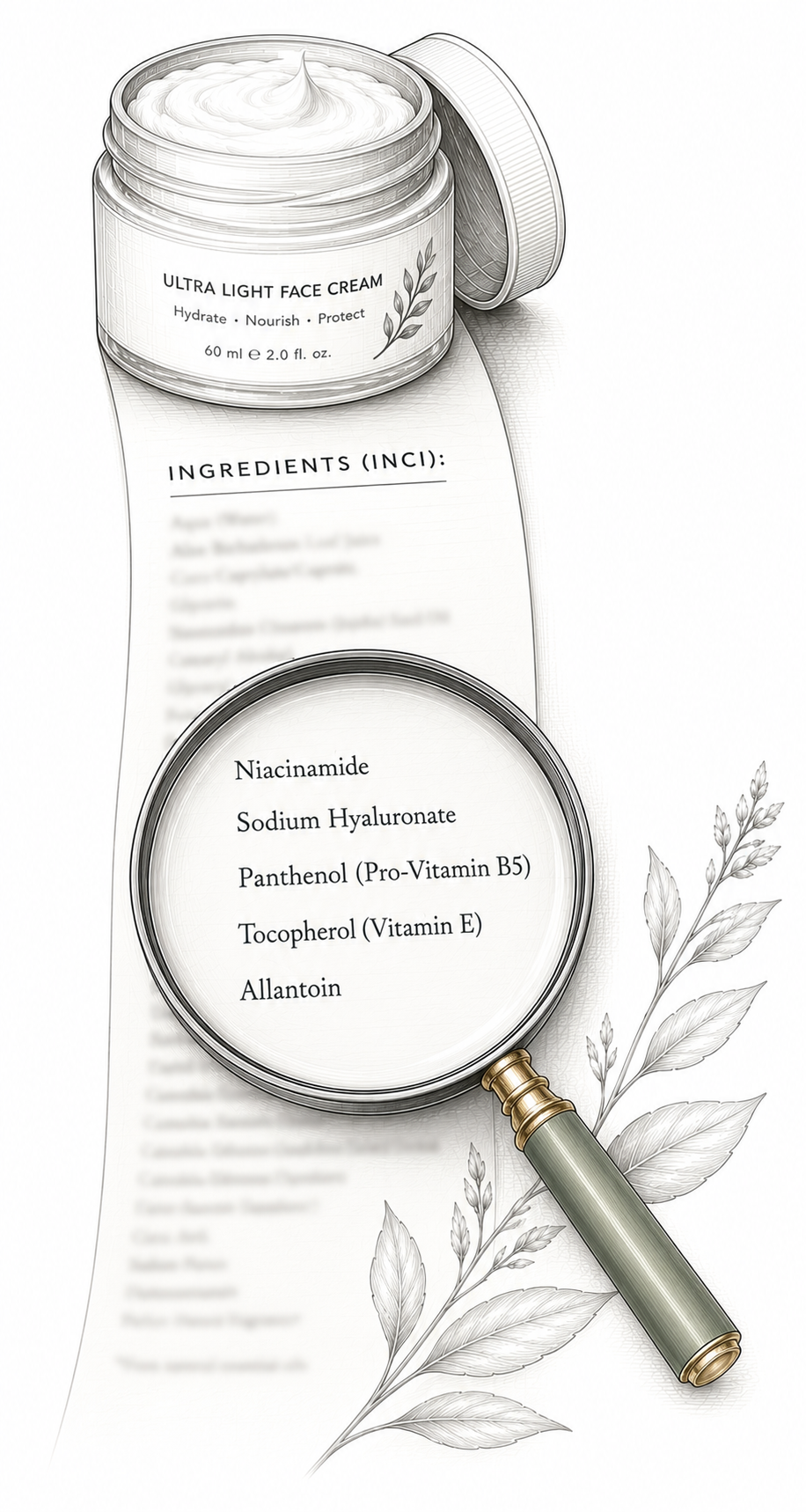
Ingredients are generally listed in descending order of concentration, which means the ingredients present in the highest amounts appear first. Water is often at the top of the list because it forms the foundation of many creams, lotions and serums.
As you read further down the label, you’ll often see a mixture of familiar names and scientific ones. Aloe vera may appear as Aloe Barbadensis Leaf Juice. Vitamin E might be listed as Tocopherol. Once you begin recognising a few of these names, ingredient lists become far less intimidating.
But here’s the part that changed the way I look at skincare.
I stopped asking, “What’s the hero ingredient?”
Instead, I started asking, “What job is every ingredient doing?”
Every formulation is made up of ingredients that each have a purpose.
Some help attract water into the skin.
Some help keep that moisture there.
Some calm irritation.
Some strengthen the skin barrier.
Others help keep the formulation stable and safe to use.
Even the ingredients that many people skip over—emulsifiers, preservatives and pH adjusters—have an important role. Without them, many products simply wouldn’t work the way they’re intended.
When I read a label today, I don’t see a list of chemicals or botanical extracts.
I see a team.
Each ingredient has a role to play, and the success of the formulation depends on how well those ingredients work together.
That’s one of the reasons I encourage people not to become too focused on a single fashionable ingredient.
A wonderful botanical extract used at a tiny concentration won’t necessarily outperform a carefully balanced formulation built around well-researched, complementary ingredients.
The next time you pick up a skincare product, try looking at the ingredient list with fresh eyes.
Instead of asking,
“Is my favourite ingredient in here?”
try asking,
“What is this formulation trying to achieve?”
You don’t need to memorise every ingredient name.
You simply need enough curiosity to begin asking better questions.
Because confidence doesn’t come from knowing everything.
It comes from understanding enough to make thoughtful choices.